Most security teams think about AI as a faster version of automation. The reality is categorically different. In this insight, Almog Ohayon, founder of TandemTrace, breaks down how AI SOC agents actually operate, and how AI agent-driven security operations change the operating model beyond feature upgrades.
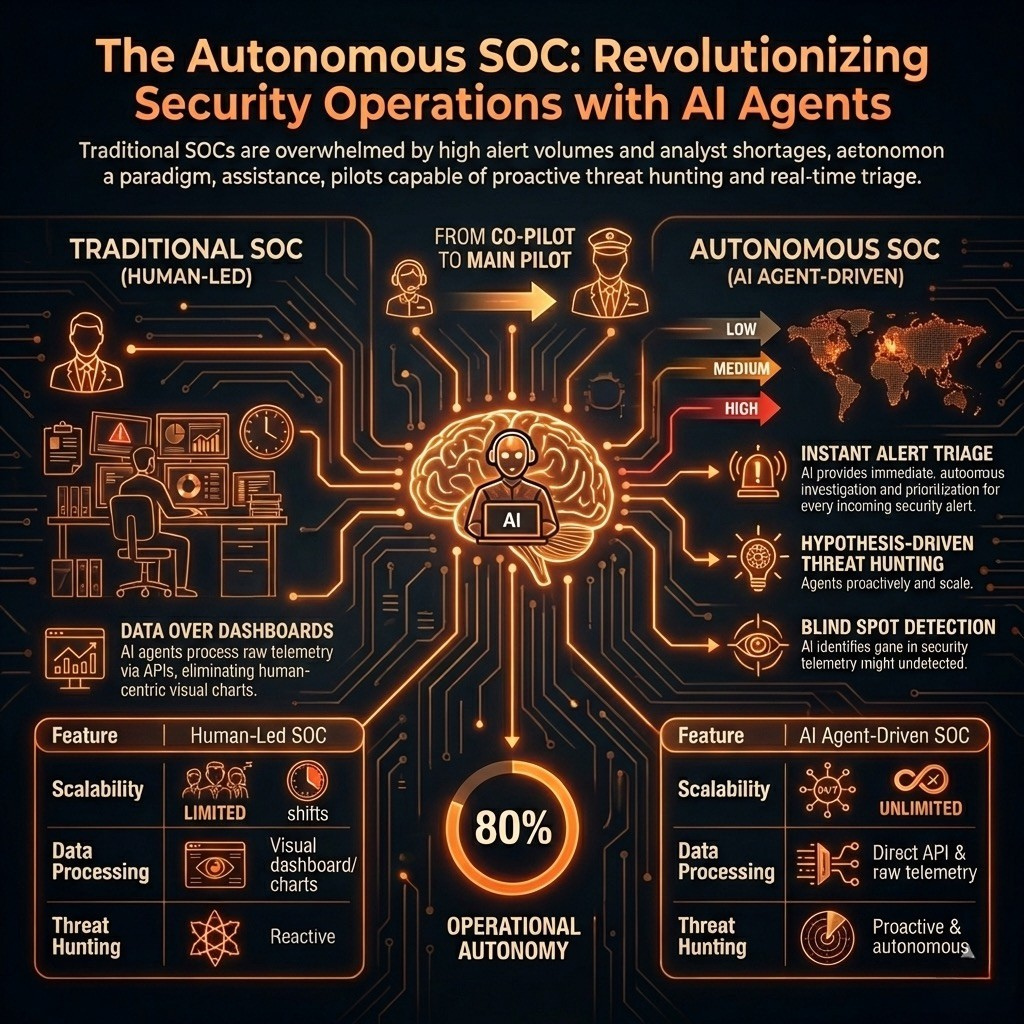
From co-pilot to main pilot
When Almog founded TandemTrace, the working assumption was that AI would assist human analysts, a co-pilot model. That assumption reversed quickly. As Almog explains, AI agents are now capable of handling 80% of the work that SecOps teams currently do manually. Humans are the co-pilots. AI agents are the main pilots.
The practical consequence is a reframing of what organizations actually need to build:
- How do we design systems where AI is the primary operator?
- Which decisions genuinely require human judgment?
- How do we give AI agents clean API access to the right telemetry?
Alert triage: the baseline, not the differentiator
Every AI SOC platform starts here. When alerts arrive, AI agents immediately investigate, prioritize, and classify, without waiting for an analyst to begin their shift. For TandemTrace, autonomous alert triage runs on day one. No training period. No ramp time.
But alert triage is the low-hanging fruit, not the differentiator. The more consequential capability is what happens to threats that never generate an alert at all.
Hypothesis-driven threat hunting at scale
Most threats don't surface through alerts. They exist quietly in telemetry, waiting. A human threat hunter can pursue a handful of hypotheses per week. An AI SOC agent can run thousands in parallel, continuously, without shift constraints or analyst bandwidth limits.
TandemTrace's approach: when new threat intelligence arrives, say, a Lazarus APT campaign using reflective DLL injection, AI agents don't wait for a triggering event. They immediately:
- Map the threat intelligence against the specific environment (Windows-only, OAuth-based, Active Directory or not)
- Build tailored hunting hypotheses for that exact combination of environment and threat profile
- Query telemetry autonomously, iterating through hunting libraries until the threat is confirmed or ruled out
- Restart the process continuously, 24/7, as new intelligence and new telemetry arrive
The two genuinely hard parts of threat hunting are knowing where to start and adapting detection logic to an unfamiliar environment. AI agents handle both, and do it at a scale and speed that has no human equivalent.
Data over dashboards
Traditional SIEMs, Splunk, Elastic, Microsoft Sentinel, were built for human operators. Charts and dashboards exist because humans need to visualize data to understand it. AI agents do not.
What AI agents need is direct API access to raw telemetry, and the intelligence to retrieve only the relevant slice. A full telemetry dataset might run to 100MB. An AI agent working a specific investigation might pull 5KB of precisely filtered data. LLM-based analysis becomes economically viable when systems retrieve the data they need instead of ingesting everything.
As Almog puts it: "The pilot in the box used to be human. Now the pilot in the box is the AI agent." The implication for security vendors and buyers alike is significant, architecture built for human operators is increasingly mismatched to how AI SOC agents actually consume data. Organizations evaluating AI SOC platforms should ask not just "what does it show?" but "how does it access data, and what does it need?"
Blind spot detection: visibility as a first-class capability
Beyond finding threats, TandemTrace surfaces what it cannot find, and explains why. If an environment is missing EDR telemetry and a finance-sector APT group relies on techniques that only surface in endpoint data, the platform flags that gap explicitly.
Analysts see detected threats alongside coverage gaps that could allow threats to go undetected. Every clustered threat the platform surfaces includes:
- A severity rating
- A false positive risk score with supporting reasoning
- An explanation of which telemetry gaps, if any, reduce detection confidence
This is different in kind from an alert score. It gives analysts the context to make informed decisions, not just reactive ones.