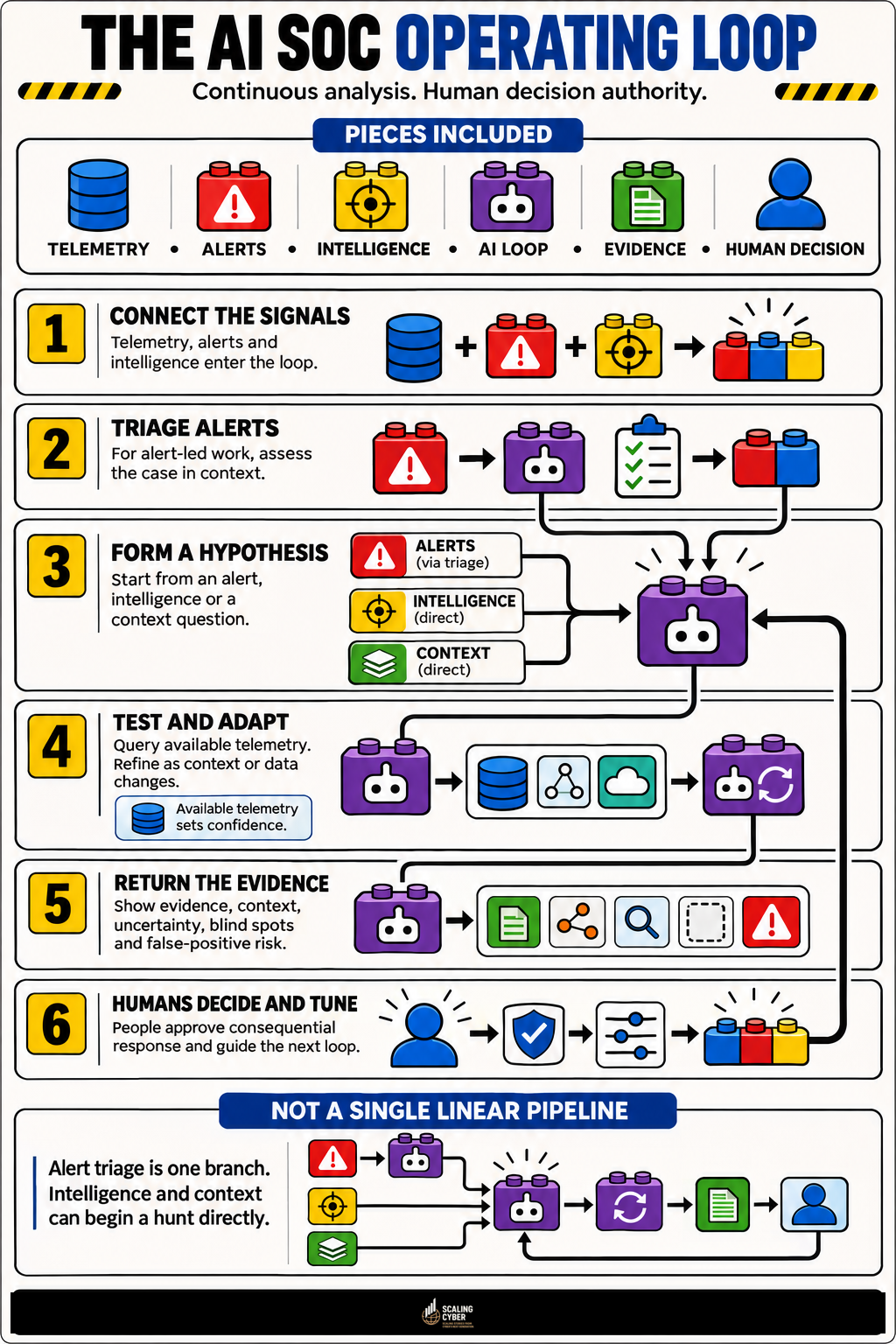
From AI co-pilot to AI pilot
The original vision for AI in SecOps was simple: Help analysts work faster.
But in less than two years, the conversation has changed. AI agents are no longer limited to assisting humans. They can now:
- Build investigation hypotheses
- Execute complex query chains
- Correlate telemetry across multiple sources
- Adapt dynamically to new threat intelligence
- Run continuously, 24/7, without fatigue
As Almog puts it, we used to design systems where the "pilot in the box" was human. Now, the pilot is increasingly the AI agent, and we are the co-pilots.
Autonomous Alert Triage: the low-hanging fruit
The first major use case for AI in the SOC is Autonomous Alert Triage.
Every SOC struggles with:
- Alert overload
- Prioritization challenges
- False positives
- Analyst fatigue
Autonomous triage means AI agents can:
- Evaluate alerts based on context
- Enrich them with relevant telemetry
- Prioritize based on risk
- Filter out noise
This alone dramatically reduces workload. But triage is just the foundation.
Autonomous Investigation: beyond dashboards and charts
Traditional SOC tools were built for humans. They rely on:
- Dashboards
- Charts
- Visualizations
- Manual pivoting between consoles
Humans need visual context. AI does not.
AI agents can ingest telemetry directly through APIs and perform investigations without dashboards. They:
- Slice only the relevant telemetry
- Correlate timeframes across systems
- Join tables and filter signals
- Conduct root cause analysis autonomously
Instead of pushing 100MB of logs to an analyst, AI agents extract the exact 5KB needed.
This marks a fundamental shift in SOC architecture: systems must now be built for machine consumption first, human review second.
Autonomous Threat Hunting: the operating change
The most transformative capability is Autonomous Threat Hunting.
Traditional threat hunting requires:
- Senior expertise
- Hypothesis building
- Manual query creation
- Deep familiarity with the environment
- Time and availability
It's slow and limited by human bandwidth.
AI agents change that equation.
Hypothesis generation at scale
AI can generate multiple starting points, even when no alert exists. It doesn't just respond to signals; it proactively asks:
- What new intelligence feeds suggest?
- What techniques are emerging?
- What blind spots might exist in this environment?
Tailored hunting per environment
An AI agent adapts to:
- A Windows-only environment
- Entra-based authentication
- Specific telemetry limitations
If data is missing, it adjusts its hypothesis. If noise is detected, it refines the query set. The process is continuous.
24/7 scalability
There are no shift changes. No "threat intel expert is off today." No limits on how many hypotheses can run.
Hunting becomes persistent and iterative.
This is not automation. This is autonomy.
SOC Automation vs. Autonomous SOC
Many organizations still equate AI with SOC Automation, rule-based workflows triggered by predefined conditions.
But automation:
- Follows scripts
- Executes predefined logic
- Breaks when conditions change
Autonomy:
- Builds and evolves hypotheses
- Learns from context
- Adapts queries dynamically
- Operates independently
The difference is the difference between a checklist and an investigator.
Decisions for security leaders
Security teams face structural constraints:
- Talent shortages
- Rising attack complexity
- Increasing telemetry volume
- Multi-step attacks spanning weeks
In many environments, investigations stop early simply because there's no time.
AI agents remove that constraint. They can:
- Reanalyze historical telemetry
- Re-evaluate past events with new intelligence
- Investigate signals that never triggered alerts
This closes one of the biggest gaps in modern SOC operations.
Time to value: days instead of years
Becoming a senior threat hunter can take years.
Deploying AI agents for Autonomous Alert Triage and Investigation can deliver value immediately.
From day one:
- Alerts can be autonomously investigated
- Simulated attacks can be detected
- Hypotheses can be tested against existing telemetry
The human role shifts from manual execution to ownership and decision-making.
The future SOC model
The emerging model looks like this:
- AI agents handle the bulk of analysis
- Humans validate outcomes and make strategic decisions
- Systems are built for machine-readable telemetry
- Hunting is continuous, not episodic
In this model, AI isn't an assistant.
AI is the pilot.