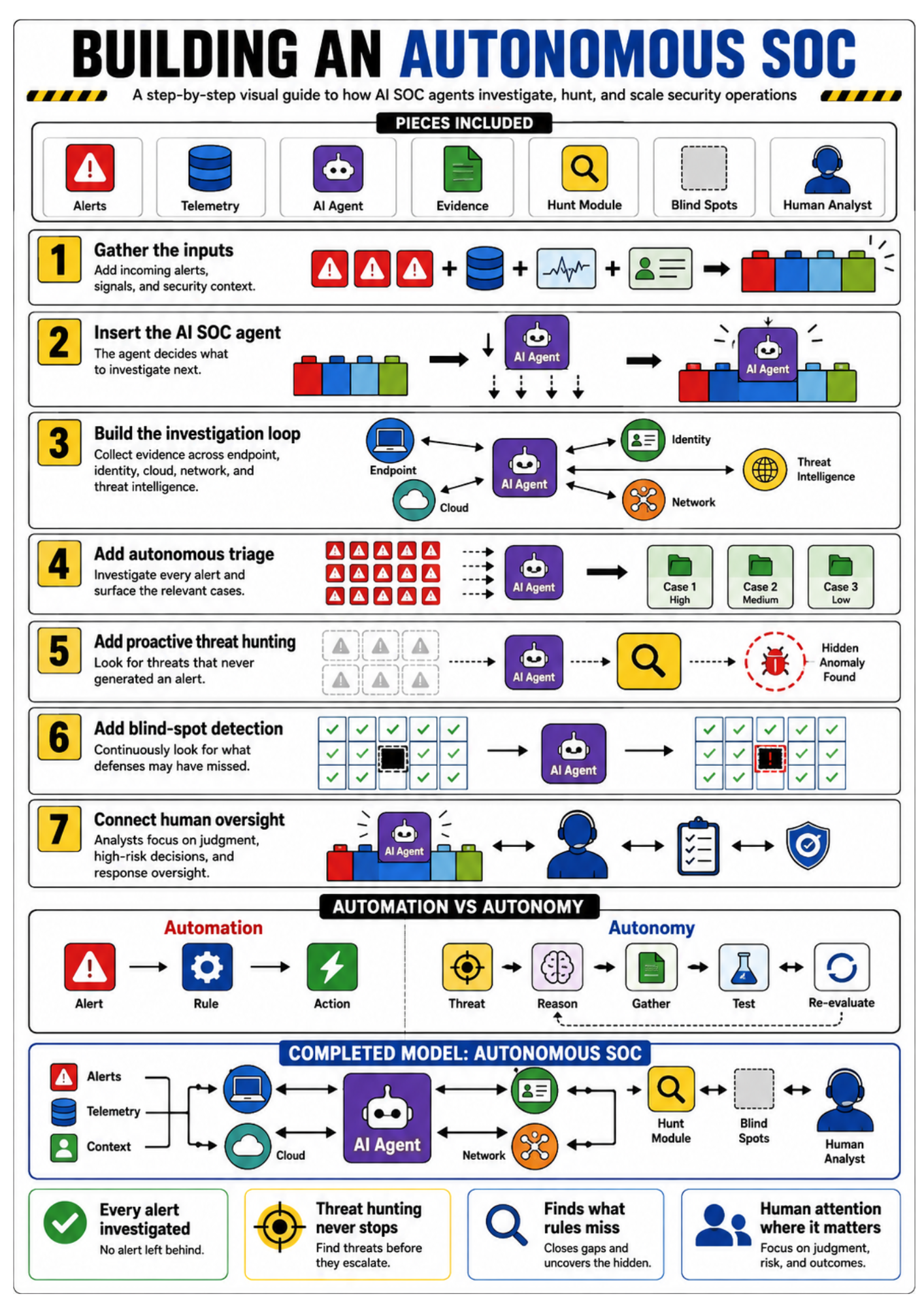
Most security leaders still think of AI in SecOps as automation, faster rules, smarter alerts, better dashboards. An autonomous SOC platform is something fundamentally different. In this insight, Almog Ohayon, founder of TandemTrace, breaks down what autonomous security operations actually means, how it differs from automation, and what to look for in a platform built to run threat hunting without human involvement.
SOC automation vs. autonomous SOC: the operating difference
The terms are used interchangeably, but they describe very different things.
SOC automation means using technology to make human analysts faster. Rules fire, playbooks run, tickets are created. A human still reviews results, decides what's real, and takes action. The analyst is the pilot; the tools are the autopilot.
An autonomous SOC inverts this. AI agents perform the analysis, build the hypotheses, run the queries, and deliver conclusions. The human reviews those conclusions and makes containment decisions. The AI is the pilot; the analyst is the co-pilot.
As Almog Ohayon explains, the shift started with alert triage, every AI SOC vendor's baseline feature, but the real distinction comes with what happens next. Alert triage is the low-hanging fruit. Autonomous threat hunting is where the paradigm actually changes.
The practical gap between the two:
- Automation reduces analyst workload; autonomous operations scale beyond what any analyst team could do
- Automation requires human-written rules and playbooks; autonomous platforms generate and test hypotheses on their own
- Automation operates on alerts that already exist; autonomous threat hunting starts from zero-alert scenarios
What an autonomous SOC platform actually does
A genuine autonomous SOC platform runs three core workflows independently:
- Alert triage: Every incoming alert above a configured severity threshold is investigated automatically, including root cause analysis, contextual enrichment, and false positive probability scoring
- Autonomous threat hunting: The platform builds threat hypotheses from threat intelligence feeds, maps them to the customer's specific environment and telemetry, executes queries, and iterates until either finding evidence of attacker activity or confirming its absence
- Blind spot detection: The platform continuously identifies gaps in the telemetry, missing EDR data, uncovered assets, logging lapses, and surfaces these to analysts with specific context on what threats those gaps leave undetectable
The false positive scoring is worth noting. Rather than passing a result to an analyst and declaring it a confirmed threat, TandemTrace attaches a false positive risk score and the security reasons behind it to every clustered alert. Analysts see what the AI found, its confidence level, and the evidence behind it.
Autonomous threat hunting: why 24/7 scale changes everything
The clearest proof of the autonomous-vs-automation distinction is how threat hunting works at scale.
A human threat hunter starts a shift, picks a hypothesis based on recent threat intelligence, queries the telemetry, and refines. This process takes hours per hypothesis and stops when the analyst's shift ends. A senior threat hunter might develop and test five or ten hypotheses per week.
An autonomous SOC platform can run continuously:
- It ingests new threat intelligence feeds in real time
- It builds tailored hypotheses based on both the intelligence and the specific environment (Windows vs. Linux, Active Directory vs. OAuth, EDR coverage vs. sysmon-only)
- It queries the telemetry, evaluates results, and generates new query sets if the first pass finds nothing
- It runs 24/7, with no shift changes, no escalation delays, and no capacity ceiling
Almog Ohayon's example: a new Lazarus campaign surfaces in a threat intelligence feed. A human analyst needs time to read it, assess relevance to their environment, build hunting logic, and run queries. An autonomous platform does this within the same window the intel was published, adapting its queries to the customer's actual telemetry rather than running generic detection rules.
Why autonomous SOC platforms need different infrastructure
Traditional SOC tooling, Splunk, Microsoft Sentinel, CrowdStrike, Elastic, was built for human operators. That means dashboards, charts, and visualizations. Humans need to see data rendered in ways they can parse quickly.
AI agents don't need any of this. They need a good API and structured telemetry access. Charts and dashboards are irrelevant to an agent running a threat hunting loop.
This has an architectural implication for vendors: building an autonomous SOC platform means designing the system for AI as the primary consumer of data, not humans. The human interface becomes a review layer on top of outputs, not the primary operational surface.
It also means rethinking how telemetry is consumed. LLMs have token limits. Sending an entire day's telemetry into an LLM is neither practical nor affordable. The platform needs to slice telemetry intelligently, pulling 10 seconds from one timeframe, 20 seconds from another, based on what's relevant to a specific hypothesis. Done well, this reduces a 100MB telemetry pull to 5KB of targeted, relevant data, which makes the AI analysis both faster and dramatically cheaper.
Deployment and data considerations
For European organizations, one practical consideration drives platform selection more than almost anything else: where the data lives.
Almog Ohayon's observation is that roughly 30–40% of enterprise customers won't connect a cloud-based platform directly to their telemetry. Regulatory requirements, data sovereignty concerns, and internal policy all create hard blockers for SaaS-only deployments. An autonomous SOC platform that can deploy on-premise or in a private cloud removes this blocker.
Data quality is the other variable. The platform performs better with richer telemetry, adding EDR data to sysmon dramatically reduces false positives for advanced threat detection. But autonomous platforms can compensate for gaps in ways human analysts cannot, because they can model what the available evidence suggests even when data is incomplete. The blind spot feature surfaces exactly these gaps, so organizations know what they can't detect and can make informed decisions about data investments.
Time to value is faster than most security buyers expect: alert investigation delivers results from day one, and threat hunting value can be demonstrated quickly by simulating attacks that don't trigger existing detection rules, then watching the platform find them anyway.
This insight comes from Scaling Cyber, a podcast hosted by Ignacio Sbampato featuring cybersecurity founders and leaders from around the world.