Deception goes beyond honeypots
One of the biggest misconceptions around cyber deception is that it equals honeypots, isolated fake systems waiting passively to be attacked.
Modern deception platforms go much further.
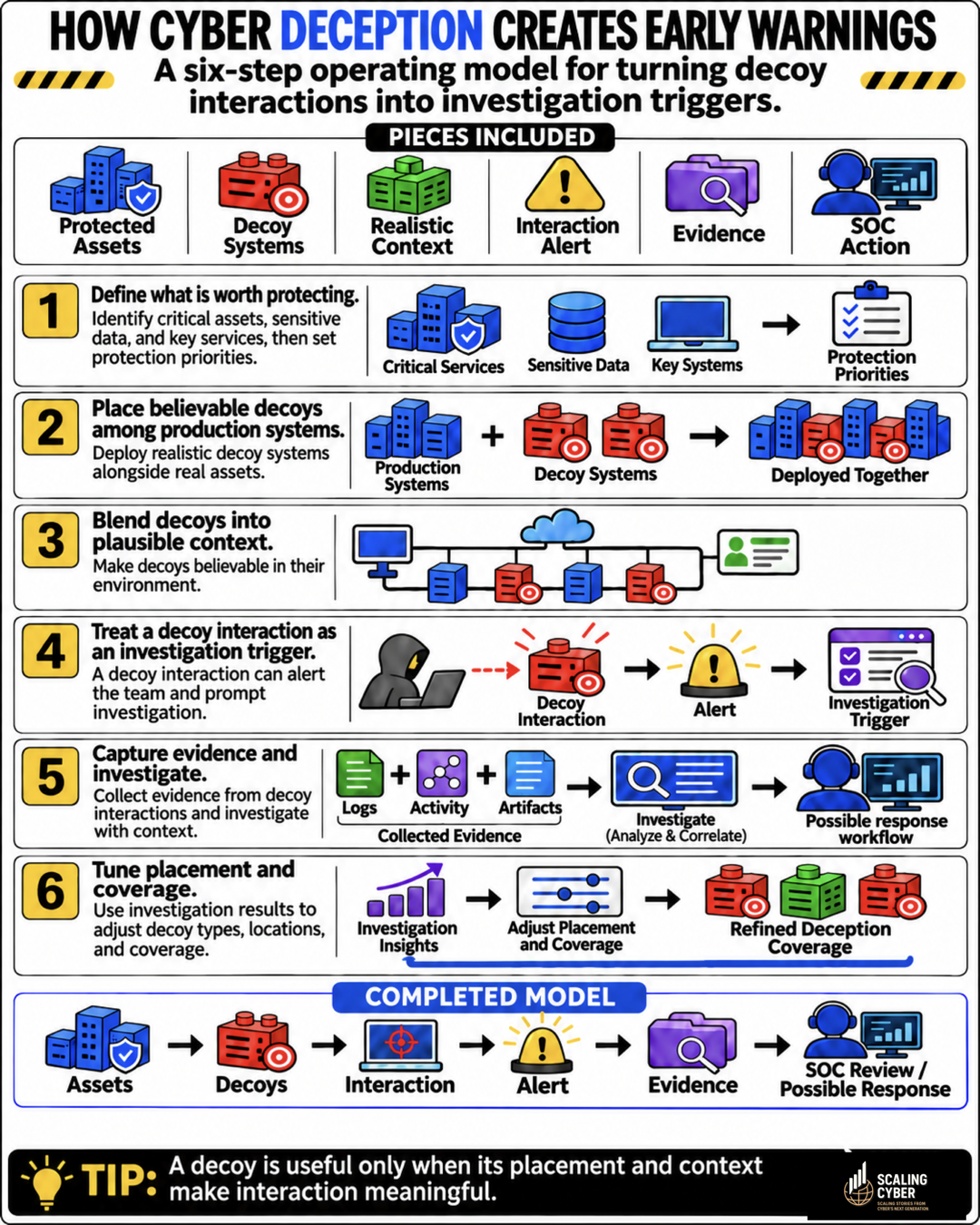
In practical terms, deception today means:
- Deploying realistic decoy assets inside production environments
- Making them indistinguishable from real systems
- Monitoring for any interaction with those assets
- Triggering alerts the moment something touches what should never be touched
Because no legitimate user or process should interact with these decoys, deception provides something most security teams desperately want: extremely high signal and near-zero false positives.
Deception as an early warning system
At its core, deception acts as an early warning system.
Instead of waiting for:
- Malware execution
- Data exfiltration
- Lateral movement at scale
Deception detects attackers at the earliest stages of intrusion, when they are still exploring, probing, and attempting to understand the environment.
The timing lowers the cost of response. The earlier an attack is detected, the lower the cost of response, both operationally and financially.
From detection to engagement
What makes modern deception especially powerful is that detection is only the first phase.
After identifying an intruder, deception can:
- Keep attackers occupied inside fake systems
- Divert them away from real assets
- Buy defenders time to investigate and respond
- Gather intelligence about attacker behavior and techniques
The goal isn't just to spot the adversary, it's to slow them down and control the engagement.
Why deception makes sense now (and not ten years ago)
So why is deception gaining traction now, after years of limited adoption?
Three major shifts are driving this change:
1. Complexity has become the norm
Modern IT and security environments are sprawling, hybrid, and difficult to fully understand. As complexity increases, so does the risk that defensive controls fail silently.
Deception provides a second chance, a way to catch attackers even when other layers don't perform perfectly.
2. Strategy outweighs individual tools
Security teams are moving away from checklist-based buying ("we need a firewall, we need an EDR") toward strategic questions:
- What is our detection strategy?
- How early can we detect an intrusion?
- How do we validate that our controls actually work?
Deception helps answer those questions by acting as a validation layer, similar to a smoke detector in a building. It doesn't prevent fires, but it tells you immediately when something is wrong.
3. The cost of late detection is too high
Attacks are becoming more sophisticated, multi-stage, and resource-intensive to investigate once they reach advanced stages.
Detecting attackers late means:
- More forensic effort
- More expert involvement
- Higher business impact
Early detection through deception dramatically reduces those downstream costs.
Deception as a benchmark for your security posture
A subtle but important point is that deception isn't just about catching attackers, it's also about testing your own strategy.
By observing:
- Which decoys are triggered
- How attackers move through fake assets
- Where alerts fire (or don't)
Organizations can identify blind spots and validate whether their overall security architecture behaves as expected.
In that sense, deception becomes both a detection mechanism and a measurement tool.