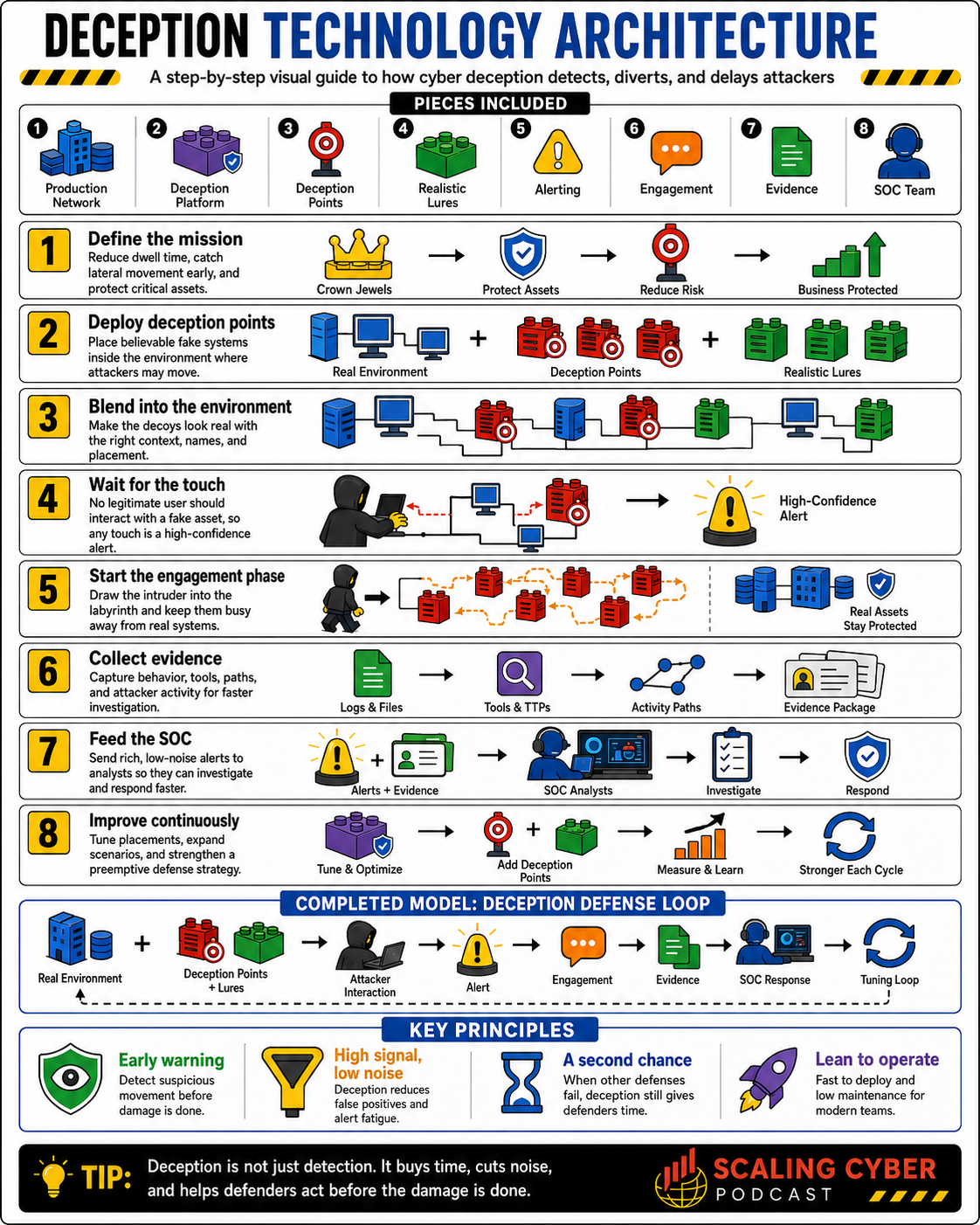
Most security teams have heard of cyber deception, but far fewer understand its actual architecture, how it deploys, how it detects, and what happens after an attacker is caught. In this insight, Pawel Rybczyk and Anastasiia Dorosh of Labyrinth walk through how modern deception technology works in practice, why it produces near-zero false positives, and how it catches identity-driven attacks that bypass almost every other tool.
Deception technology is not a passive honeypot
The most persistent misconception about cyber deception is that it equals honeypots, isolated, static systems sitting somewhere in a corner of the network, waiting indefinitely to be hit. Modern deception technology architecture is fundamentally different.
What Labyrinth deploys is a network of "points": decoy assets distributed throughout the production environment and designed to be indistinguishable from real systems. The key architectural principle is integration. The decoys don't sit on the edge of the network, they live inside it, alongside legitimate infrastructure, blending in at the level of network topology, naming conventions, and service behavior.
The logic that makes this work is simple: no legitimate user or process should ever interact with a decoy. There is no reason for a real workstation, a real application, or a real user to touch these assets. If anything does touch them, the alert is valid, by definition.
Why deception produces near-zero false positives
False positives are the operational nightmare of modern security. AI-based detection systems, behavioral analytics, and SIEM correlation rules all generate noise. Analysts spend hours chasing alerts that turn out to be nothing.
Deception technology eliminates that problem structurally, not algorithmically. The architecture doesn't try to distinguish malicious behavior from benign behavior using statistical models. It simply monitors assets that should never be touched. Any interaction, a ping, a login attempt, a credential query, is an alert worth investigating.
As Pawel explains, this isn't a product claim; it's testable from day one. Labyrinth validates deployments by inviting red teams and penetration testers into customer environments without telling them the deception layer is active. The red teamers probe the network as they normally would, and every alert that fires is a real finding. No tuning required. No threshold calibration. The architecture makes the signal clean.
The engagement phase: keeping attackers inside the maze
Detection is only phase one of the deception technology architecture. What happens after an attacker touches a decoy is what separates modern platforms from legacy honeypots.
Once contact is made, the platform shifts into engagement mode. The goal is not just to alert, it's to:
- Keep the attacker occupied inside fake systems
- Divert them away from real assets and sensitive data
- Buy the defending team time to investigate and respond
- Gather intelligence about attacker techniques, tooling, and movement patterns
This is where the Labyrinth name becomes literal. Attackers who probe a decoy don't hit a wall and turn around, they enter a maze of realistic but fake infrastructure with no exit. While they explore, defenders observe. The attacker wastes time and reveals their methods; the organization loses nothing.
Where deception catches what other tools miss: identity-driven attacks
One of the most important capabilities of deception technology architecture is its effectiveness against identity-based intrusions, a category of attack that defeats most conventional security controls.
As Anastasiia describes from field experience, identity-driven attacks work by abusing legitimate credentials. The attacker is authenticated. The system recognizes them. From the perspective of a firewall, an EDR, or an IAM tool, everything looks normal, because technically it is. A valid user performing technically permitted actions triggers no alert.
Deception catches this because the architecture doesn't rely on behavior being "wrong" by any normal measure. It only requires that the attacker, while moving through the environment with valid credentials, touches something they have no legitimate reason to touch. That interaction is the signal. The attacker's privileges are not decisive. Their authentication is not decisive. The moment they probe a decoy, they're detected.
Deception as a validation layer for your security strategy
Beyond active detection, deception technology architecture serves a second function that security leaders increasingly value: it tells you whether the rest of your security strategy is actually working.
Pavel frames it as a smoke detector analogy. You can have sprinklers, fire doors, and evacuation plans, but if you never test the smoke detectors, you don't know if the system works. Deception provides continuous, passive validation of your detection posture. If an attacker gets deep enough to touch a decoy, you learn exactly where the other layers failed, and at what stage the intrusion was finally caught.
This shifts deception from a point solution to a strategic benchmark. Security teams can use it to:
- Identify blind spots in existing detection coverage
- Validate that behavioral analytics and SIEM rules are firing correctly
- Measure how early in the attack chain threats are being caught
- Inform decisions about where to invest in defensive improvements
Gartner now classifies this approach under preemptive cybersecurity, a shift from reactive detection toward proactive posture management. According to Pawel, Gartner projects that preemptive security tools will grow from around 5% of security strategies today to roughly 50% by 2030. Deception technology is a core component of that shift.
This insight comes from Scaling Cyber, a podcast hosted by Ignacio Sbampato featuring cybersecurity founders and leaders from around the world. Watch the full episode: Episode 3, Labyrinth →