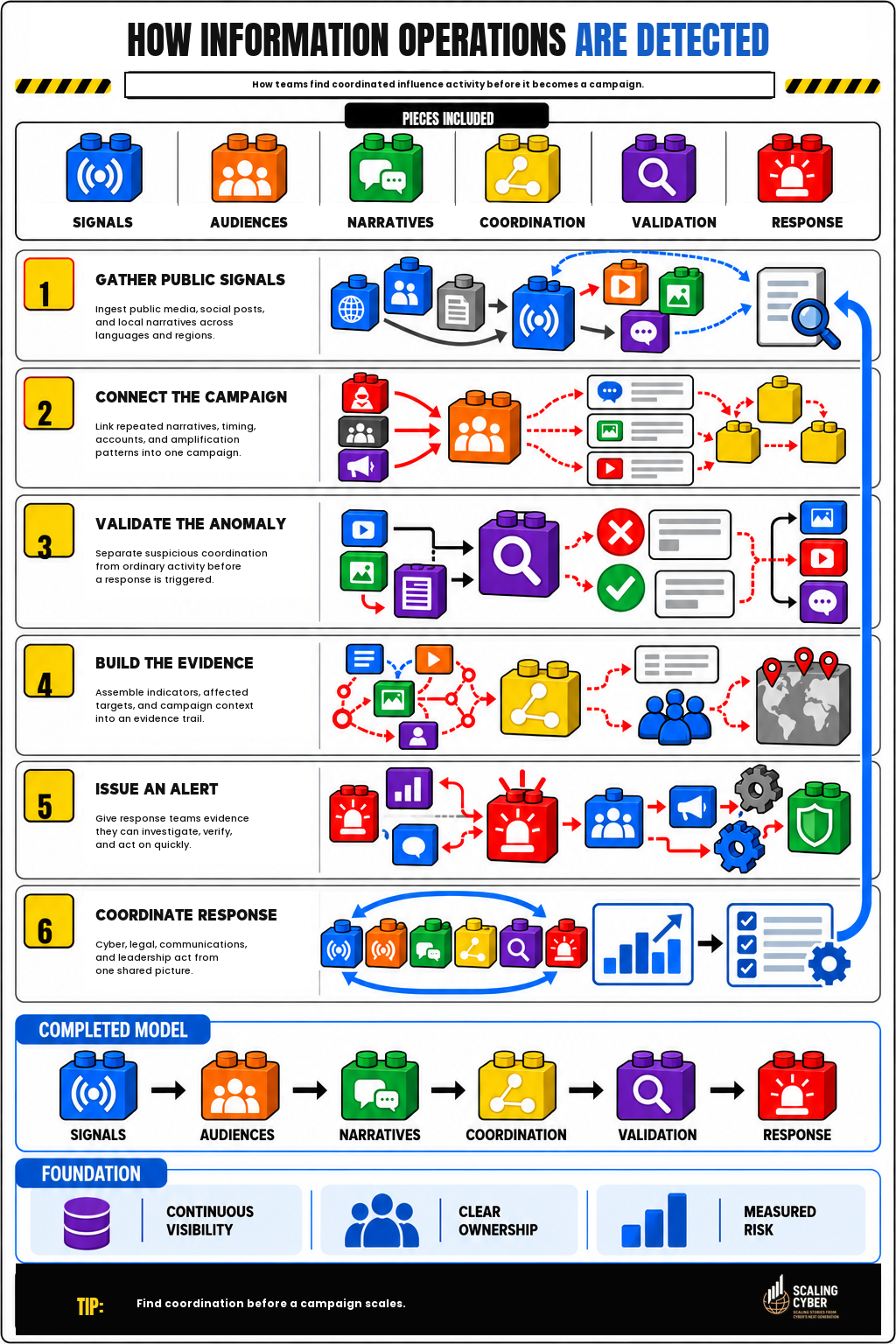
Information operations are often treated as abstract, state-sponsored threats or something limited to elections. In reality, they are commercially driven, highly scalable campaigns that increasingly target banks, brands, and enterprises across multiple countries at once.
In this insight, Andriy Kusyy, co-founder of LetsData, breaks down how modern information operations really work, and why companies that rely only on US- or English-centric threat intelligence are already behind.
Information operations don't respect borders
One of the most dangerous assumptions organizations still make is that information operations are local.
In practice, campaigns routinely:
- Start in one country
- Test narratives in smaller or less monitored markets
- Scale across multiple regions
- Operate in parallel across languages
As Andriy explains, a single campaign can originate in Southeast Asia, test first in Central or Eastern Europe, and then scale into Western Europe, all while defenders in major markets only see it once it's already effective.
By the time it shows up in English-language monitoring, the damage is already done.
Why "global" intelligence is often too late
Many threat intelligence platforms focus primarily on:
- US-based sources
- English-language media
- Large, mature markets
This creates blind spots.
Campaigns often incubate in:
- Local languages
- Regional media ecosystems
- Smaller markets with less scrutiny
A campaign that starts in Romanian, Russian, Ukrainian, or Czech may circulate for weeks, building credibility and reach, before ever appearing in English. When detection finally happens, organizations only see a fragment of a much larger operation.
Multilingual from day zero is the new normal
A major shift highlighted in this episode is that multilingual campaigns are no longer a sign of low quality.
Thanks to automation and generative AI:
- Campaigns launch in multiple languages simultaneously
- Poor translations are no longer a reliable detection signal
- "Patient zero" is already multilingual
In one example, a single narrative circulated across multiple languages and countries, gradually building audience trust in each region before converging on a final target market. Without cross-language correlation, each piece looked insignificant on its own.
Together, they formed a coordinated operation with millions of views.
What modern information operations target
Information operations are no longer just about misinformation for political influence. Increasingly, they are financially motivated and tightly integrated with cybercrime.
Examples discussed include:
- Bank executives impersonated in ads and social posts
- Fake replicas of trusted media outlets like the BBC or Financial Times
- Crypto scams branded as legitimate bank investment products
- Credential harvesting and malware distribution
- False rumors designed to impact stock prices or trigger bank runs
- Fake recruitment campaigns using synthetic employee identities
These are multi-step, credibility-driven operations, not simple phishing attempts.
Information ops + cybercrime = one ecosystem
A key insight from this conversation is that information operations and traditional cyber threats are no longer separate domains.
They work together:
- Information operations create trust and narrative
- Cybercrime exploits that trust for financial gain
- Reputational damage and customer harm happen simultaneously
This makes detection harder, and response more urgent, because the victim can include the organization, its customers, partners, and employees.
Why early detection changes the economics of attacks
Despite the growing sophistication, there is a structural weakness attackers still have: economics.
While creating content is cheap, running a full campaign requires:
- Infrastructure
- Coordination
- Time to build funnels and credibility
If defenders can detect campaigns at inception, they:
- Force attackers to absorb the upfront cost
- Prevent returns on investment
- Shut down campaigns before scale
Early detection allows organizations to:
- Take down malicious assets
- Warn customers proactively
- Neutralize campaigns before they reach critical mass
This is where distributed, multilingual intelligence becomes a defensive advantage.