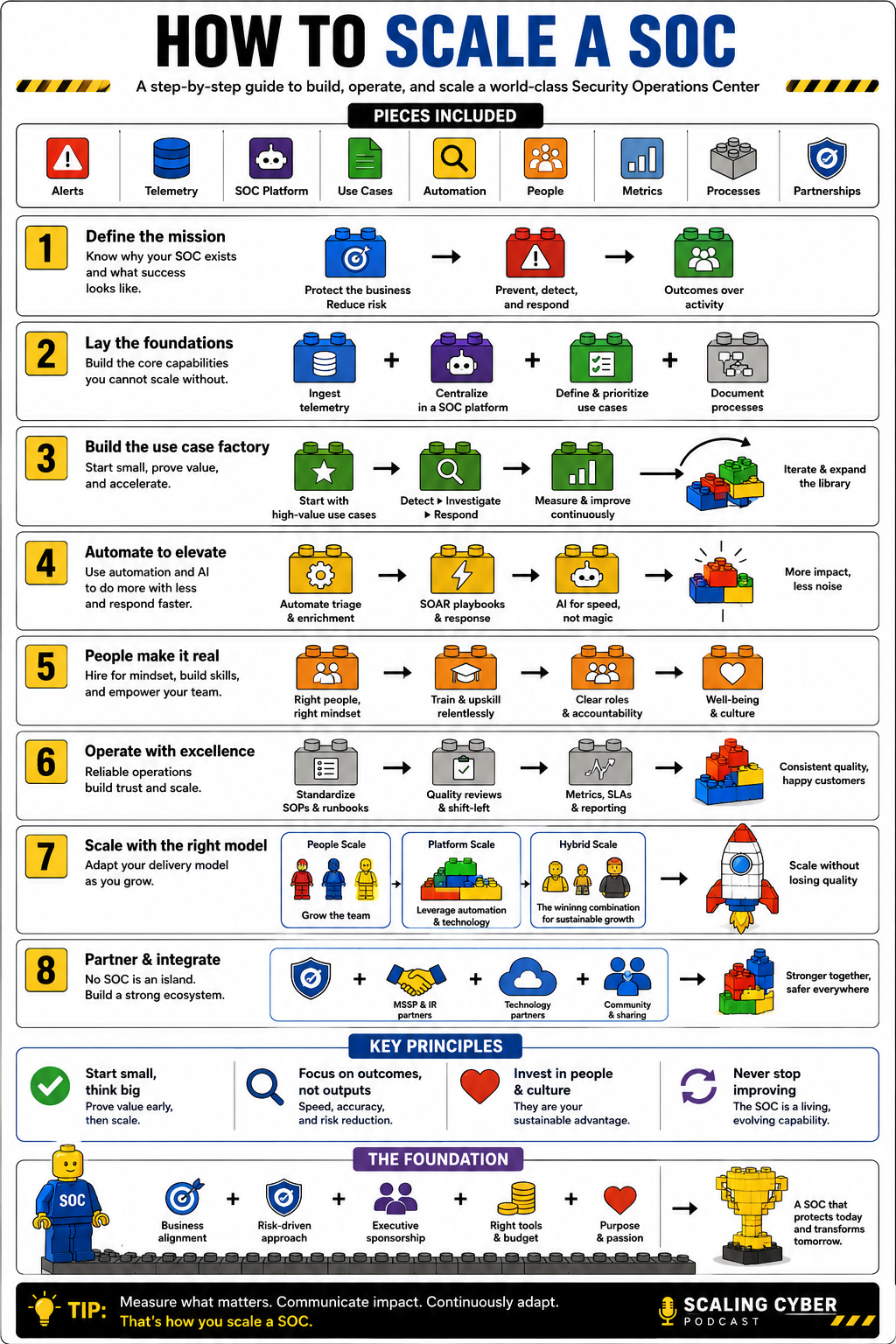
Scaling a SOC comes down to one counterintuitive decision: support fewer tools, not more. Here's the operational playbook behind growing from 5 to 50+ monitored customers with the same lean team and without a proportional increase in analysts.
What you'll learn
In this article:
- Why supporting fewer vendor combinations is how you scale faster
- The two operational metrics that determine whether a SOC can grow beyond its headcount
- How to build automation your customers will actually trust
- Where AI genuinely helps, and where it breaks MDR environments
The trap most MDR providers fall into
The default pitch in managed detection and response sounds reasonable: "We support your existing stack, any SIEM, any vendor, custom workflows." It's how you win early deals. It's also how you build something that's impossible to maintain at scale.
Federico spent years learning this the hard way, including a failed SOC attempt in the US market before joining ACEN. The lesson:
- Every additional SIEM requires separate detection rules, separate parsing logic, separate API integrations
- Unmaintained SIEMs at customer sites generate a flood of untuned alerts, "a Christmas tree," as he puts it
- Context switching between different vendor environments destroys analyst productivity
- Custom workflows for individual customers don't compound, every edge case breaks the next one
Supporting everything means doing nothing well. Operational efficiency requires the opposite.
Standardization as the scaling engine
ACEN's contrarian approach: pick the 20% of technologies that cover 80% of the market, commit to them deeply, and build everything else around that foundation.
In practice, this means:
- Choosing a specific SIEM stack and owning it end-to-end, including maintenance
- Selecting two or three EDR vendors and mastering them rather than accepting everything
- Targeting a specific market segment, for ACEN, construction, healthcare, and government in Belgium, where customers rarely arrive with existing SIEMs
- Showing prospects the operational efficiency gain of standardization, not just the features
The onboarding story changes when the customer doesn't have to maintain their own SIEM. As Federico explains to prospects: one fixed price, one vendor responsible for everything, SIEM, SOC, detection, maintenance. One fewer license to manage. The pitch lands because the value is concrete.
Once you commit to a standard stack, patterns emerge. Most customers share the same three or four firewall vendors, the same antivirus options, the same Microsoft and Active Directory environment. Detection rules start to compound. Onboarding becomes repeatable. The team gets better faster.
The two metrics that define SOC health
Scaling a SOC with limited staff comes down to two numbers. Federico keeps them front and center for every decision at ACEN:
- Customer-facing efficiency: What percentage of alerts can you resolve without contacting the customer, through containment, automated action, or a templated notification?
- Operational efficiency: Of those, how many were resolved without a human analyst involved?
The ratio between these two metrics determines whether a SOC can grow or stays capped by headcount. It's the closest thing to a universal benchmark for security operations at scale.
Building automation customers will actually trust
Automation is how ACEN moved from 5 to nearly 50 monitored customers without a proportional increase in analysts. But the journey wasn't instant.
In 2021-2022, ACEN built a fully autonomous playbook for Microsoft 365 alerts, tight logic, real functions, less than 1% error rate, with full visibility into failures. When they showed customers, the reaction was immediate: "I want humans in the process."
That resistance is real, and Federico takes it seriously. The approach that works:
- Start with a narrow, well-tested automation with measurable accuracy
- Show customers the error rate and the failure-detection mechanism
- Expand scope incrementally as trust builds
- Never automate a flow that can't be applied across multiple customers, custom automations break the model
The result of getting this right: analysts spend their time on genuine investigation and edge cases, not on routine alert handling. The SOC can cover more customers with the same team.
AI's practical role in scaling security operations today
AI is the current buzzword in security operations, but the gap between the marketing pitch and what works in a real MDR environment is significant.
Where AI delivers real value right now:
- Structured enrichment from unstructured inputs, extracting key fields from phishing emails or ambiguous alerts into a JSON output that triggers a precise automation. No human needed to read and classify.
- Detection rule drafting, AI can generate a useful starting point for new rules, cutting initial engineering time
Where the limits are clear:
- Full AI agents require customers to use a specific, homogeneous vendor stack. Most MDR customers have mixed environments, which breaks the integration assumptions most AI SOC tools are built on.
- Natural language queries against SIEM data are hit-and-miss. A junior analyst trusting an AI-generated query may believe they've reviewed all relevant logs when the query was silently wrong.
- Detection engineering is expensive and hard to maintain regardless of AI assistance, which is why out-of-the-box vendor rules are making a comeback.
The future Federico sees is an abstraction layer that standardizes vendor input and output across the stack, a security mesh that makes orchestration possible regardless of the underlying tools. The analyst's role shifts from alert handler to quality assurance: ensuring the machine runs correctly, catching what automation misses, and maintaining the detection logic that drives everything else.
This insight comes from Scaling Cyber, a podcast hosted by Ignacio Sbampato featuring cybersecurity founders and leaders from around the world.