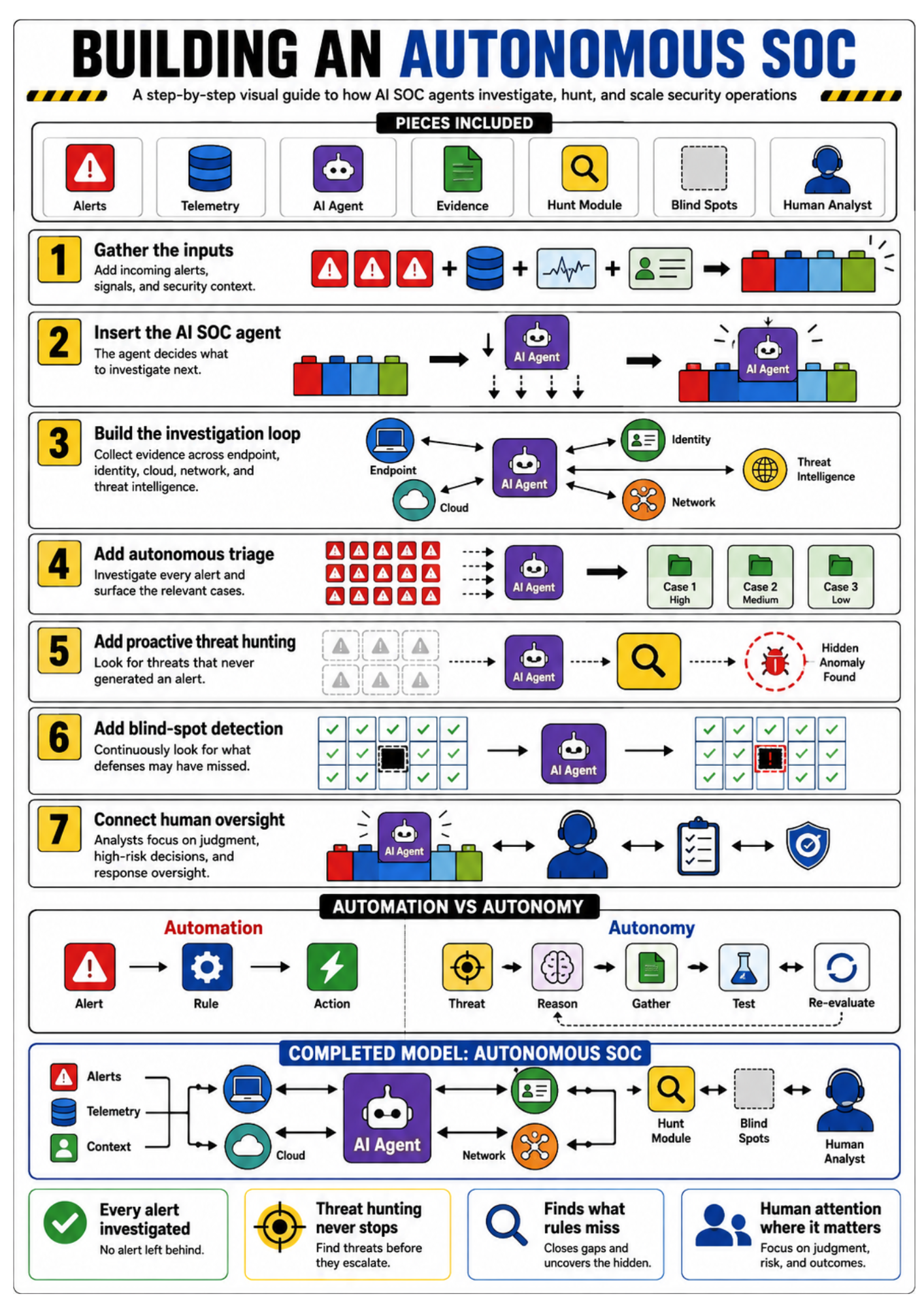
Most security teams today believe they are adopting AI. What many are actually adopting is better automation, and that distinction is becoming one of the most consequential blind spots in modern SecOps.
The terminology doesn't help. Vendors use "AI-powered", "intelligent", and "autonomous" almost interchangeably in their marketing. Analyst firms lump rule-based workflows and AI agents under the same umbrella. And in most platform demos, the difference is invisible, both show dashboards, both surface alerts, both claim to reduce analyst workload.
But the underlying architecture, the capabilities, and the operational outcomes are meaningfully different. Understanding that gap is no longer an academic exercise. It's a strategic decision for any security leader evaluating where to invest next.
In this article, I want to draw a clear line between the two, what automation is, what autonomy actually means in a SOC context, and why the distinction changes everything from how teams are structured to how telemetry should be architected. I'll draw on my recent conversation with Almog Ohayon, co-founder of TandemTrace, who has built and sold security products across two very different technology eras and has some of the sharpest thinking I've encountered on this topic.
Let's get into it.
What SOC Automation Actually Is
SOC automation has been around for over a decade. SOAR platforms, Security Orchestration, Automation and Response, made it mainstream. The core idea is straightforward: take repetitive, well-defined tasks and execute them through predefined playbooks, freeing analysts for higher-order work.
At its best, automation handles things like:
- Phishing triage: ingest email, extract IOCs, check against threat intel feeds, auto-close if benign
- Alert enrichment: pull context from EDR, SIEM, and CMDB automatically when a rule fires
- Incident ticket creation: open, assign, and route tickets without human intervention
- Containment actions: isolate an endpoint when a specific rule fires with high confidence
These are real productivity gains. Any SOC running purely on manual workflows in 2025 is leaving significant efficiency on the table. Automation reduces mean time to triage, shrinks analyst queue backlogs, and ensures consistent handling of known alert types.
But here is the structural limitation: automation follows scripts. It executes predefined logic. When conditions change, it breaks.
If a threat actor uses a technique slightly outside the playbook's parameters, the automation doesn't adapt, it either misfires or falls silent. If a new attack campaign emerges that doesn't match any existing rule, automation has nothing to offer. The entire model is reactive and bounded by what a human thought to write a rule for in advance.
Almog put it directly: "Most people who don't spend their nights with AI still think about AI as an automation tool. Many people don't really understand the big difference between automation and autonomous."
That confusion costs organizations detection capability when automation is presented as autonomy.
What Autonomous Actually Means
Autonomy in a SOC context is not just faster automation. It is a fundamentally different operating model.
An autonomous SOC system doesn't follow scripts, it builds hypotheses. It doesn't wait for a rule to fire, it proactively asks questions of the telemetry. It doesn't fail when conditions change, it adapts its query strategy based on what it finds and what it doesn't.
The clearest way to illustrate this is through threat hunting, which has historically been one of the most resource-constrained activities in any security operation. Traditional threat hunting requires a senior analyst with deep knowledge of the environment, time to formulate hypotheses, expertise in writing complex queries, and the availability to run iterative investigations. In most SOCs, that profile is rare, expensive, and constantly in demand for incident response.
Autonomous threat hunting changes the equation entirely. As Almog described in our conversation, TandemTrace's agents approach it this way: a new threat intelligence feed arrives, say, indicators of a Lazarus Group campaign using reflective DLL injection. The system doesn't just match IOCs. It:
- Understands the specific environment (Windows-only, Entra-based authentication, specific telemetry sources available)
- Formulates tailored hunting hypotheses based on both the intel feed and the environment's characteristics
- Executes queries, evaluates results, and evolves the hypothesis set if early queries return nothing
- Continues iterating, adjusting for noise, filling gaps where telemetry is partial, until it reaches a conclusion with a stated confidence level
"The AI can constantly now build new hypotheses and check them autonomously," Almog explained. "It builds based on a specific starting point. And then it validates and does all the query and tedious parts. If it doesn't find signals, it might evolve into more and more query sets until you're certain that attack doesn't exist in the telemetry."
This is not a playbook. There is no human who pre-wrote the logic for that specific Lazarus variant in that specific environment. The system is reasoning, and it is doing it 24/7, without fatigue, without shift changes, without a senior analyst needing to be on call.
The Architecture Shift Nobody Is Talking About
Here is the part of this conversation that I found most striking, and that I believe is significantly underappreciated across the industry.
The tools we have built to run SOCs were designed for humans. Dashboards, charts, visualisations, pivot tables, drill-down UIs, all of it exists because human analysts need to ingest and make sense of data visually. We can't read raw telemetry JSON. We need context rendered as a chart before we can spot a pattern.
AI agents don't need any of that.
As Almog put it: "AI doesn't need charts and dashboards. All it needs is a good API and access to the telemetry data. Then I can do all the processes that a human was doing manually, root cause analysis, pivoting between data sources, autonomously, without dashboards."
This reframes a question that security vendors haven't fully confronted yet: if the primary analyst in your SOC is an AI agent, why are you building the product around human interfaces?
Almog describes the emerging model as "pilot in the box." For decades, the pilot in the box was a human. The entire tooling stack was built around surfacing information for that human to act on. Now, the pilot is increasingly the AI agent, and humans move into a co-pilot role, validating outcomes, making strategic decisions, handling escalations.
This has a concrete implication for how telemetry should be structured. Rather than sending everything to the SIEM and building dashboards on top, organisations need to think about telemetry as API-first data infrastructure, structured for machine consumption, not human visualisation.
TandemTrace, for instance, doesn't ingest the full telemetry. It slices only what's relevant to the investigation at hand, pulling a 10-second window here, a specific host's activity there, joining tables across sources to extract 5KB of high-signal data from what might be 100MB of raw logs. That precision is necessary because LLMs have context limits, and irrelevant data degrades output quality and increases cost.
This is a design philosophy, not just a product feature. And it signals what the next generation of SOC tooling will need to look like.
The Practical Difference in SOC Operations
Let me make this concrete with three operational scenarios where the distinction between automation and autonomy becomes visible.
Alert Investigation
With automation, an alert fires, a playbook runs, enrichment data is pulled, a ticket is opened. If the enrichment matches a known pattern, the alert is closed or escalated. If it doesn't, it lands in an analyst queue.
With an autonomous agent, the alert is not just enriched, it is investigated. The agent builds a hypothesis about what the alert represents, examines correlated activity in the surrounding timeframe, checks for related signals that didn't trigger alerts, and delivers a reasoned conclusion with a false positive probability score and an explanation of any data gaps that affected the analysis.
The output is not a ticket. It is a finding, with context, reasoning, and confidence, ready for a human decision-maker to act on.
Coverage Without Alerts
Automation only operates on signals. If no rule fires, nothing happens.
An autonomous system can proactively hunt for threats that never triggered an alert, simulating attack scenarios against the existing telemetry, testing whether specific techniques would be detectable given current data coverage, identifying blind spots. TandemTrace surfaces this as explicit visibility: if an organisation is missing EDR telemetry, the system flags which attack categories become undetectable as a result.
This is qualitatively different from anything a SOAR playbook can do.
Time to Value
Bringing a senior threat hunter up to speed in a new environment takes months. Building that expertise to the level where someone can reliably hunt for novel campaigns takes years.
An autonomous agent is operational from day one. As Almog described: "Day one, day two, you start to see the value. You almost don't need human experts, you need decision-maker experts to deal with the results. But in terms of getting value, you get it very immediately. You don't need years."
Security leaders evaluating autonomous tooling should compare time to contribution with the time required to hire and develop human expertise, rather than focus on feature lists.
What This Means for Data Quality
One of the more nuanced points in my conversation with Almog was around data quality, and it cuts against a common excuse I hear from security teams for not moving faster on AI adoption.
Many organisations hold back because they believe their data isn't good enough. The telemetry is incomplete, inconsistent, or poorly structured. "We need to fix our data first," the argument goes.
The reality, as Almog explained, is more layered. AI agents can compensate for incomplete data better than human analysts can, they're better at reasoning from limited signals, inferring context from partial information, and flagging where data gaps increase false positive risk. A human analyst presented with incomplete telemetry often either misses the threat or wastes hours chasing noise. An AI agent can assess the gap, adjust its confidence, and communicate the limitation explicitly.
That said, data quality still affects results at the margins. Richer telemetry, particularly EDR data, dramatically reduces false positive rates for sophisticated threats. The difference between detecting a Lazarus-style APT with sysmon-only data versus having full EDR coverage from Microsoft Defender or CrowdStrike is significant.
The practical guidance here is not "fix everything before you start." It is: start now, understand what your telemetry gaps are, and use the agent's blind spot analysis to build a data improvement roadmap. The two workstreams run in parallel, not in sequence.
The Organisational Implications
If autonomous agents handle the bulk of analysis, investigation, and hunting, what does the human team look like?
This is where I see a genuine transition happening, and it deserves more attention than it typically gets in vendor conversations. The role that scales down is the tier-1 and tier-2 analyst, the person who triages queues, enriches alerts, and runs basic investigations. These tasks are precisely what autonomous agents handle best.
The role that scales up is the decision-maker: someone who reviews agent findings, applies business context, approves containment actions, coordinates with leadership, and manages the overall security posture. That person needs judgment, communication skills, and strategic awareness, not necessarily deep technical expertise in query languages.
For MSSPs and large enterprise SOCs, this has significant workforce planning implications. The pyramid flips: fewer junior analysts, more senior decision-makers, and AI agents filling the operational gap in between.
I believe this transition will happen faster than most organisations are prepared for. The teams that start reorienting now, training their analysts to work alongside autonomous agents, restructuring how findings are reviewed and acted on, will have a meaningful head start.
Final Thoughts
The gap between SOC automation and SOC autonomy is not a marketing distinction. It is an architectural one, an operational one, and increasingly a competitive one for the organisations that run security operations at scale.
Automation made SOCs more efficient at handling known, well-defined scenarios. Autonomy extends the SOC's capability into territory that was previously out of reach, proactive hunting, continuous hypothesis testing, coverage across threats that never generate alerts, without requiring headcount that doesn't exist.
What Almog and TandemTrace are building is one of the clearest examples I've seen of what the autonomous SOC model looks like in practice: agents that reason, adapt, and operate at machine scale while keeping humans appropriately in the loop for consequential decisions.
I believe the conversation in the industry needs to catch up to what is already being built. Too many security leaders are evaluating "AI" products that are, at their core, better automation with a language model bolted on top. The question to ask any vendor is not "do you use AI?", it's "can your system build a hypothesis it has never seen before and test it against my environment tonight while my team sleeps?"
That's the bar. And it's a meaningful one.
The pilot in the box is changing. Make sure your stack knows who, or what, is flying.