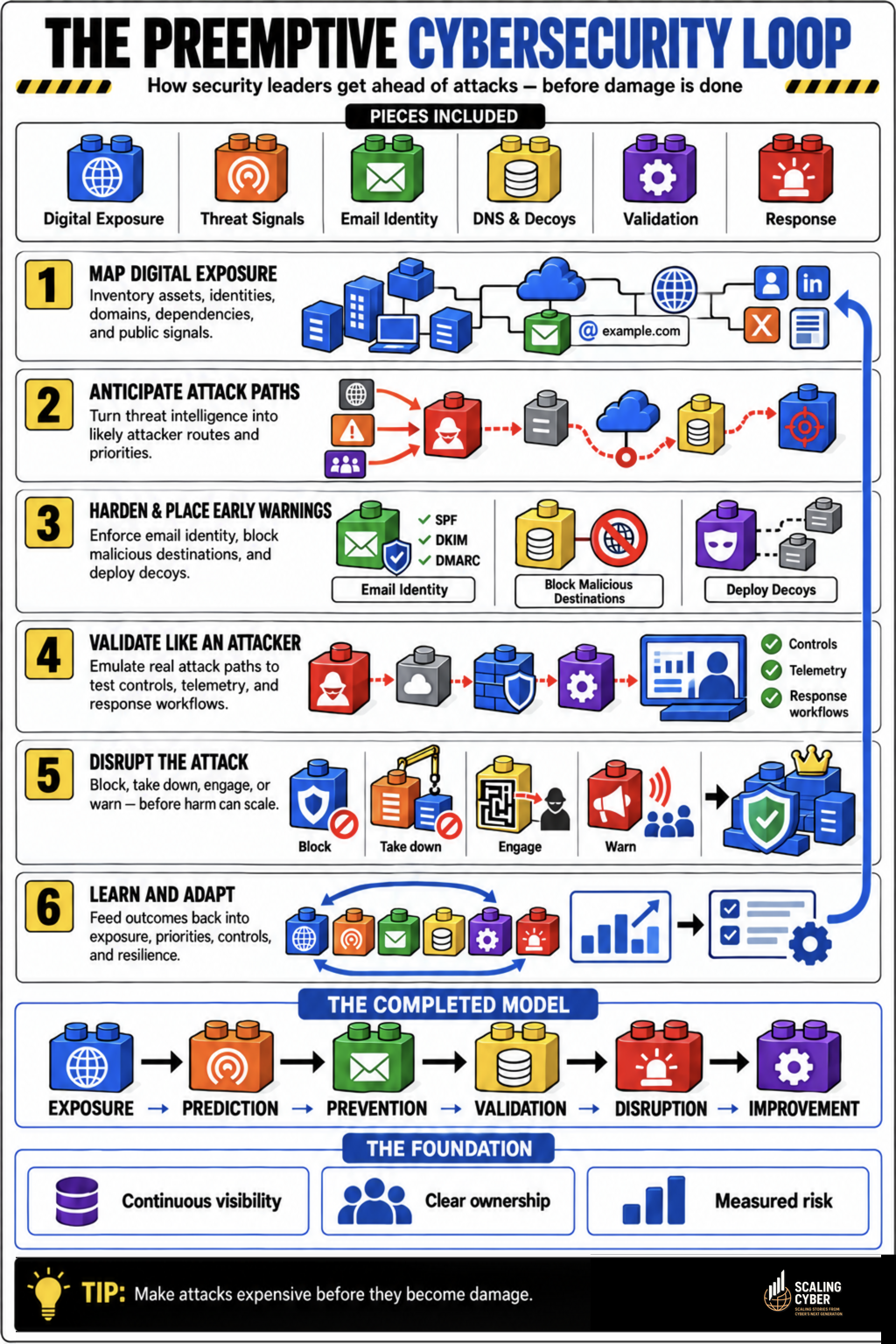
The security industry has spent decades optimizing for response. Detect the breach, contain the damage, learn the lesson. But a growing cohort of security leaders, and a formal Gartner category, argues this model has a fundamental flaw: by the time you're responding, the attacker has already won. Preemptive cybersecurity takes a different approach: stop threats before they cause harm, not after. In this insight, founders and security leaders from across the Scaling Cyber podcast break down how preemptive security works in practice, from predictive threat intelligence and cyber deception to continuous validation and protocol-level defense.
What preemptive cybersecurity means and when to act
Preemptive cybersecurity is a Gartner-recognized category covering tools and strategies that act before attackers achieve their objectives, rather than after. It spans several disciplines: predictive threat intelligence, cyber deception, breach and attack simulation, continuous threat exposure management (CTEM), and attack surface management.
The Gartner projection that signals the momentum shift: preemptive security tools are used by roughly 5% of organizations today. By 2030, that figure is expected to reach 50%. The tools already exist. The adoption curve is the story.
What unites these approaches:
- Acting before damage occurs, not after detection
- Changing the economics of attacks, making them more expensive and less predictable for attackers
- Shifting from "assumed breach" as a worst-case scenario to active deterrence as a first principle
- Treating the attacker's perspective as a design requirement, not an afterthought
Predicting attack infrastructure before attacks launch
Luigi Lenguito, CEO of BforeAI, frames the problem through an analogy: the Iron Dome doesn't wait for a missile to hit, it intercepts in flight. Active cyber defense does the same thing at the infrastructure level.
BforeAI's approach, called Precrime, maps and predicts the infrastructure attackers will use before campaigns go live. This isn't threat intelligence after the fact. It's predictive threat intelligence that identifies malicious domains, IPs, and staging infrastructure days or weeks before an attack is launched. Organizations block attack infrastructure before it ever reaches their users.
The scale of the problem BforeAI addresses: over 40 million people protected daily across their customer base. And the confidence in their predictions is backed by a commercial guarantee underwritten by Munich Re, if a predicted threat causes harm, BforeAI covers the loss.
Active defense at this level isn't just a posture. It's a business model.
Catching campaigns before they scale
Andriy Kusyy, co-founder of LetsData, applies the preemptive model to information operations, coordinated disinformation campaigns that spread across social platforms, news channels, and messaging apps.
The conventional approach detects campaigns after they've already spread. LetsData's system identifies them at what Andriy calls "patient zero", the inception point, before the content has been amplified. At that stage, the campaign can be stopped or disrupted before it achieves scale.
The operational metrics: 97% of LetsData alerts are acted upon, an unusually high signal-to-noise ratio for any threat intelligence product. The system monitors content across 34+ languages, because most information operations don't start in English.
The economic logic mirrors that of physical security: catching a campaign before it reaches thousands of accounts is exponentially cheaper than countering it after it goes viral. Proactive cybersecurity that targets the root of a campaign changes the ROI calculation for the attacker.
Cyber deception: making attackers work for nothing
Pawel Rybczyk and Anastasiia Dorosh, co-founders of Labyrinth, operate in the cyber deception space, one of the oldest ideas in security, now formalized within Gartner's preemptive cybersecurity framework.
Labyrinth deploys fake decoy "points", servers, credentials, services, that are indistinguishable from real assets to an attacker. Any attacker who touches them is flagged immediately, with near-zero false positives. Legitimate users never interact with decoys. Attackers do.
Pawel's demonstration to prove the concept: invite a red team to perform a penetration test without telling them Labyrinth is deployed. The deception layer catches them within hours. Real-world attackers, who typically move more cautiously across longer timeframes, are caught even earlier.
Cyber deception and honeytokens shift the burden to the attacker: every move they make risks exposure, and they can never fully trust the environment they've entered. That is moving target defense through strategic deception that turns attacker patience against them rather than technical obfuscation.
Validating defenses from the attacker's perspective
Nils Karn and Kennedy Torkura, co-founders of Mitigant, address a different preemptive question: whether your defenses actually work when tested, beyond detecting attackers.
Mitigant runs continuous cloud security validation through attack emulation, simulating real attacker behavior against cloud environments to find the blind spots that attackers would find first. The model borrows from chaos engineering: the assumption isn't that systems will hold, but that unknown failures exist and need to be found before they're exploited.
The Mitigant approach:
- Assumes breach from the start, models what happens when an attacker gains initial access
- Maps cloud environments continuously for exploitable misconfigurations and attack paths
- Emulates real attack paths, not synthetic benchmarks
- Validates that detection and response tools trigger correctly when needed, rather than only in a tabletop exercise
Breach and attack simulation at this level is also automated penetration testing, but continuous, not annual. The attacker's advantage has always been time and patience. Continuous validation removes that advantage before it can be leveraged.
Protocol-level preemption: DMARC and Protective DNS
Two Scaling Cyber guests operate at the infrastructure and protocol level, preventing entire categories of attack by design rather than by detection.
Sacha Matulovich, CEO of Sendmarc, frames DMARC as preemptive email defense. A properly configured DMARC policy stops email impersonation before any message reaches a human recipient. There is no social engineering attempt to detect, no phishing link to flag, no user judgment required. The protocol rejects the attack at the mail server level. As Sacha describes it: getting the job done before it even reaches the humans.
Richard Malovic, CEO of Whalebone, applies the same logic at the DNS layer. Protective DNS filters malicious traffic at the moment a device resolves a domain name, before any connection is established, before any payload is delivered. This happens at the network level, without requiring software installed on endpoints. Whalebone's telco partnership model extends this protection to over a billion people globally.
Both approaches share a defining characteristic of preemptive cybersecurity: the attack vector is addressed structurally, not through after-the-fact detection. No alert. No analyst. No response window. The attack simply doesn't reach its target.
Why preemptive security is gaining momentum now
The reason the adoption curve is accelerating comes down to economics and scale. AI-powered attacks are faster, cheaper to launch, and harder to distinguish from legitimate traffic. Detection-only models that relied on dwell time for investigation are under pressure. And the asymmetry between attacker and defender, attackers need to succeed once; defenders need to succeed every time, has never been starker.
Agentic AI cybersecurity tools are beginning to automate the preemptive cycle: continuously mapping exposures, predicting likely attack paths, validating controls, and deploying deception, without waiting for an analyst to initiate the process. The autonomous SOC model that several Scaling Cyber guests describe isn't built on faster response. It's built on eliminating the need to respond at all.
The 5% to 50% shift Gartner projects isn't a prediction about technology readiness. The technology is ready. It's a prediction about how quickly organizations will recognize that the reactive model has reached its limits.