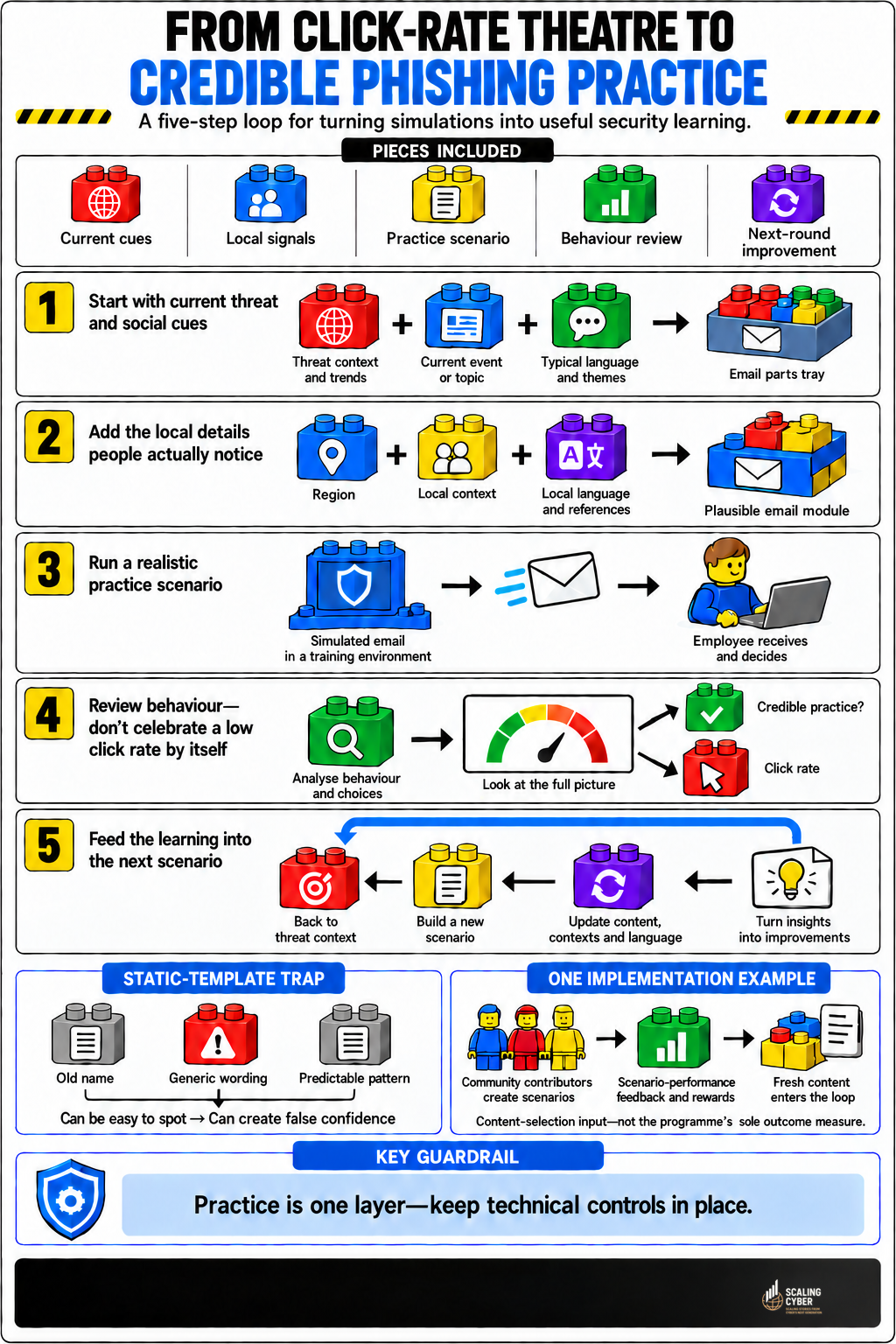
Most organisations running phishing simulations are not getting the results the research promises because their execution is weak. Scientific studies show that done well, phishing simulation meaningfully improves human security behaviour; done poorly, it can make things worse. In this insight, Simon Bauwens, co-founder of OutKept, breaks down why template-based platforms fall short and what effective phishing simulation actually requires.
The research is clear, but execution is not
There is a genuine scientific debate in cybersecurity about whether security awareness training works. Simon's view, built on extensive reading of that research: the debate is being framed wrong. The question isn't whether phishing simulation works, it's whether organisations are doing it well enough for the research to apply to them.
Studies consistently show a split outcome:
- High-quality phishing simulations, with realistic content and proper follow-through, demonstrably improve employee behaviour over time
- Poor-quality simulations, obvious, outdated, or technically implausible, produce a negative effect, eroding trust without building better reflexes
The difference between these two outcomes is almost entirely execution.
Why template-based phishing simulation fails
The most common phishing simulation approach is template libraries: a vendor maintains a set of pre-built phishing emails that organisations select and send. The problem is structural. Templates age, and attackers don't wait for quarterly updates.
Simon's example is straightforward: sending an employee a phishing email about Twitter in 2024 is immediately suspicious, because everyone knows the platform rebranded to X. The simulation is technically a phishing email, yet no one clicks because the content is obviously out of date rather than because of better security instincts. The result is a false positive on training effectiveness.
The failure modes of template-based platforms:
- Content becomes outdated faster than vendor update cycles
- Templates are built for one language market and adapted poorly for others
- Simulations are often technically distinguishable from real phishing (sent from internal domains, obvious formatting tells)
- Low click rates get reported as success when they may simply reflect implausible content
Local language is a bigger factor than most platforms admit
Europe makes the execution challenge concrete. A phishing email written in standard Dutch will feel off to someone in Flanders, the phrasing is subtly different from what Dutch speakers in Belgium use day to day. The same applies across the Baltic states, Belgium's three national languages, and dozens of regional variations across the continent.
For global platforms headquartered in the US, building genuinely local content across dozens of European markets is commercially unattractive. The economics don't work for a vendor selling a centralised library. As a result, employees in smaller language markets can dismiss simulations because the content is not credible, regardless of their training.
Effective phishing simulation requires content that mirrors what real attackers actually send in a given language, region, and cultural context, including references to local events, local services, and local idioms that a real threat actor targeting that workforce would use.
The community model: applying bug bounty logic to phishing
OutKept's approach is to replace the centralised template library with a community of ethical phishers, individuals who create phishing emails on the platform and are paid based on the success rate of their submissions, in the same structure as bug bounty programmes in cybersecurity.
The model solves the core problems of the template approach:
- Currency: Community members create content continuously, referencing current events, new services, and emerging social engineering tactics in real time
- Local depth: A community of contributors naturally includes people who speak minority languages and understand regional context that no central team would resource
- Competitive incentive: Phishers are paid by success rate, so they're motivated to create content that genuinely fools people, not content that looks like a phishing simulation
The competitive element is part of the design. Contributors track performance, compete for "fisher of the month" recognition, and earn ongoing bounties from emails that remain in circulation. The gamification keeps the community active without requiring constant management.
AI is raising the stakes, on both sides
As AI tools make it easier to generate convincing phishing emails at scale, the bar for simulation content rises. Real attackers are already using AI to make their campaigns more localised and more plausible. Phishing simulation platforms that don't evolve alongside those tools will fall further behind.
OutKept's position is to integrate AI into the community model rather than replace the community with AI. Contributors already use AI tools to produce better phishing content, the platform tracks success rates regardless of how an email was created. The competitive structure channels AI capability toward better simulations, rather than trying to automate the process centrally.
Simon's framing: one AI algorithm optimised to produce the best phishing email is less powerful than a community of contributors competing with their own AI tools in parallel.
NIS2 is creating compliance demand, and quality pressure
The EU's NIS2 directive is making cybersecurity awareness training mandatory for a broader set of organisations across critical sectors. For phishing simulation vendors, this creates a significant market opportunity, but it also raises the quality question urgently. Organisations implementing phishing simulation to meet a compliance requirement have every incentive to pick the cheapest option that generates a report.
Simon's view is that compliance can drive real improvement if vendors and buyers focus on documented behavioural outcomes rather than click-rate statistics. Showing regulators that employee behaviour changed, not just that simulations were run, is the direction the market is moving.
NIS2 compliance that relies on low-quality simulation may satisfy a checkbox while failing to improve the organisation's actual security posture.
This insight comes from Scaling Cyber, a podcast hosted by Ignacio Sbampato featuring cybersecurity founders and leaders from around the world. Watch the full episode with Simon Bauwens, co-founder of OutKept →
Related insights: